


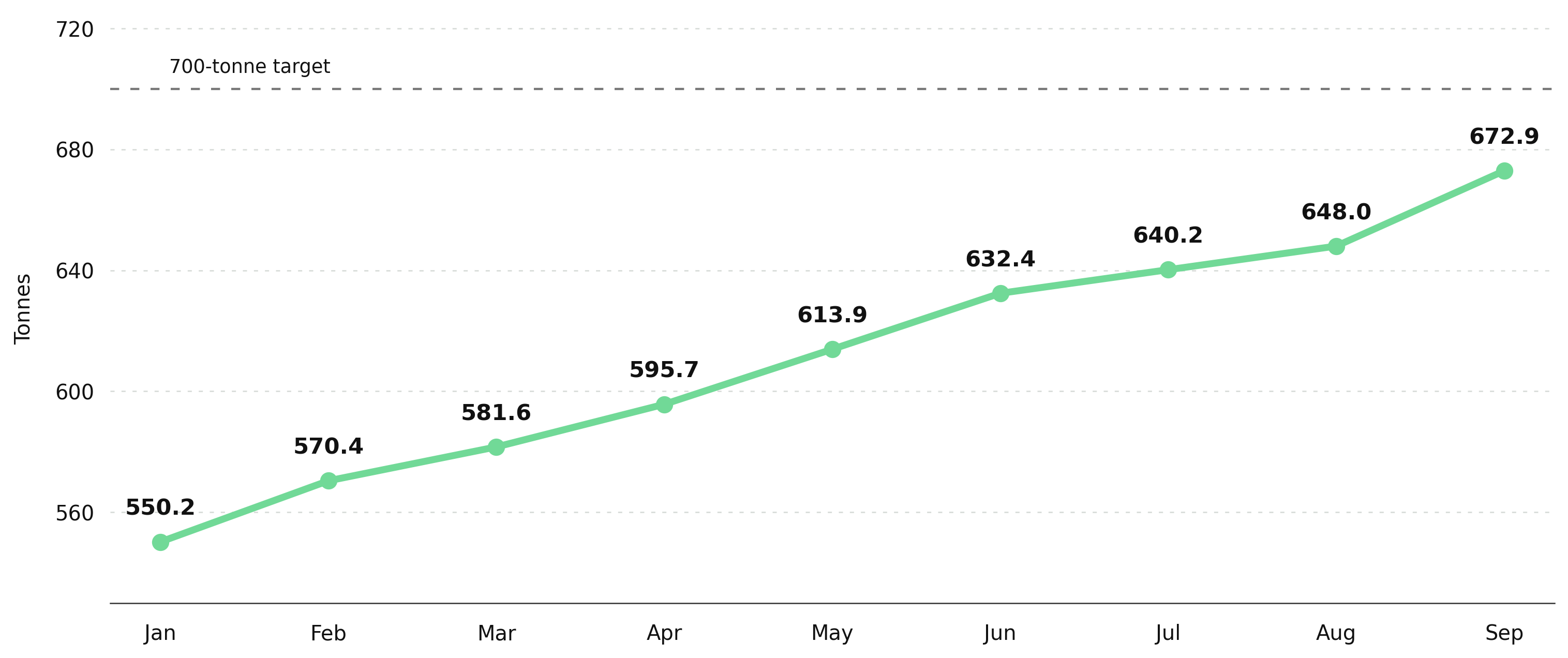
The National Bank of Poland (NBP) added about 123 tonnes of gold in the first nine months of 2026, lifting reserves to 672.9 tonnes against a 700-tonne target. Central banks keep buying, yet total gold supply was largely unchanged year over year in the second quarter.
Poland Moves Ahead of China in Disclosed Buying as Its Target Nears
September purchases of about 24.9 tonnes took Poland's nine-month total past China's reported 103-tonne increase. The buying advances a long-term reserve diversification strategy and adds physical demand beyond short-term investment flows, though purchases could slow as the NBP nears its target.
Central-Bank Gold Buying Has Doubled to Roughly 1,000 Tonnes a Year
According to the World Gold Council (WGC), central banks bought about 1,000 tonnes a year over the past four years, double the previous decade's average. In its June survey of 76 institutions, 89% expected global central-bank gold holdings to rise over the next 12 months, and 45% planned to add to their own.
Central-Bank Purchases Rebound to a Record Second Quarter After a Slow Start
Net central-bank purchases reached an estimated 288.9 tonnes in the second quarter, up 62% year over year and the highest second-quarter total on record, though first-half buying was the lowest since 2022. Reported central-bank net gold purchases reached about 39 tonnes in August.
Total Gold Supply Stays Flat as New Mine Output Trails Higher Prices
Gold mine production rose 2% to 965.6 tonnes in the second quarter, while recycling fell 6%, leaving total supply largely unchanged. The WGC found higher gold prices have historically coincided with rising mining capital spending, with new production following at least six years later.
Feasibility-Stage Gold Projects Give Junior & Mid-Tier Miners a Growth Route
Sustained central-bank gold demand provides a supportive long-term market backdrop for undeveloped gold projects. The feasibility study from U.S. Gold Corp ($USAU.US) for its CK Gold Project in Wyoming estimates a US$632 million after-tax NPV at a 5% discount rate, based on the study’s assumed metal prices.
George Bee, President and Chief Executive Officer, points to portfolio expansion among junior and mid-tier miners:
"We see that there are lots of junior, mid-tier companies that really need to add to their portfolio. If you don't grow, you fall behind."
Most New Resources Come From Expanding Existing Projects
S&P Global identified 258 initial gold resource announcements between 2020 and 2025, totaling 189 million ounces. Only 45% came from greenfield assets, placing resource expansion and economic studies at the center of future mine supply.
Preliminary Economic Studies Test Which Deposits Could Become Mines
For large deposits, preliminary economic assessments test whether grade, mining methods and development costs support viable production. Tudor Gold ($TUD) hosts 24.9 million ounces of Indicated gold resources at Goldstorm, within its 80%-owned Treaty Creek Project in British Columbia, and a PEA of a potential higher-grade underground mine is nearing completion.
Exploration Budgets Jump 38% as Expansion Drilling Feeds Updated Resource Estimates
Gold exploration budgets rose 38% to US$8.5 billion in 2026, preliminary industry data show, funding more expansion drilling. P2 Gold ($PGLD) has extended gold-copper mineralization at its Gabbs Project in Nevada, with an updated resource estimate targeted for the fourth quarter of 2026 and a feasibility study for the first quarter of 2027.
Official Demand Builds for Years While New Mine Supply Takes Longer
National reserve targets create physical demand beyond short-term investment flows, and survey results point to wider central-bank interest in holding more gold. With new production trailing higher prices by several years, developers and explorers play a central role in the future supply pipeline.
Which Projects Stand First in Line to Re-Rate
Official buying remains strong while total supply stays flat, and new mine supply takes years to arrive. Developers with defined economics and explorers converting drilling into resources hold the clearest path, with project values re-rating as resource estimates and feasibility studies due through the first quarter of 2027 confirm viable production.
Read more: Poland's 123-Tonne Gold Buying Reinforces Long-Term Official Demand
Disclosure: This article features U.S. Gold Corp, Tudor Gold and P2 Gold as company examples. None of the companies had influence over the topic, thesis, or conclusions of this article, and none exercised editorial control over its content.
