

For Canadian microcap investors, Canaf Investments is one of the more unusual opportunities on the TSX Venture Exchange. Unlike many venture-listed companies that rely on continual equity financings, Canaf is profitable, cash-generative, debt-free, and trades at a valuation that appears disconnected from its underlying earnings power and asset value.
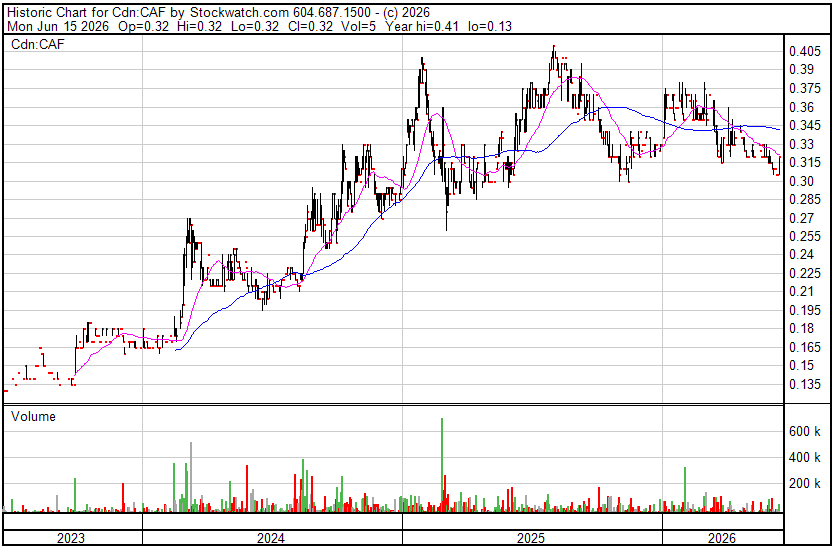
The market's lack of interest is understandable. Canaf operates in South Africa, serves industrial markets, has limited trading liquidity, and is not a "story stock." However, those same factors may be creating an opportunity for patient value-oriented investors.
Investment Thesis
The Canaf investment case rests on five pillars:
Consistent profitability
Strong cash generation
Significant net cash position
Trading below intrinsic value
Optionality from new growth initiatives
At a time when many TSXV companies remain unprofitable, Canaf generates real earnings and real free cash flow.
Company Overview
Canaf Investments is a Canadian holding company whose primary asset is a 70%-owned South African subsidiary called Southern Coal.
Southern Coal produces calcined anthracite, a specialized carbon product used primarily by manganese smelters.
The business takes raw anthracite coal and upgrades it into a higher-value industrial input used in metallurgical processes.
Its primary customers are manganese producers in South Africa.
While the business may not sound exciting, it occupies an important niche within South Africa's industrial supply chain.
Understanding Southern Coal
Many investors incorrectly assume Southern Coal is simply a coal producer.
It is not.
The company is a value-added processor.
Southern Coal purchases anthracite coal and processes it into de-volatilized anthracite (calcined anthracite), which serves as a substitute for metallurgical coke in manganese smelting operations.
The key advantages of the business include:
Established customer relationships
Specialized processing infrastructure
High switching costs for customers
Limited competition
Attractive operating margins
This has allowed Southern Coal to remain profitable through various commodity cycles.
Financial Performance
Fiscal 2025 Results
Revenue: approximately $27.7 million
Net income attributable to shareholders: approximately $2.4 million
EPS: approximately $0.051
Adjusted EBITDA exceeded $3 million.
For a company with a market capitalization near $15 million, these numbers are impressive.
Q1 2026 Results
Revenue declined to approximately $6.2 million from $8.4 million in the prior-year period.
However, the company still generated:
Net income attributable to shareholders of approximately $520,000
Adjusted EBITDA of approximately $656,000
While volumes softened, the business remained profitable.
That is a key distinction.
Many industrial businesses experience cyclical fluctuations in revenue, but profitability is what ultimately matters.
Balance Sheet Strength
The balance sheet may be the most attractive aspect of the story.
Recent figures show:
Metric Value
Cash ~$9.7 million
Working Capital ~$13.5 million
Shareholders' Equity ~$17.1 million
Debt Minimal
This means a significant portion of the company's market capitalization is backed by cash.
Few Canadian microcaps trade with this level of financial strength.
Valuation
Assuming:
Market capitalization: ~$14–15 million
Net income: ~$2.4 million
The stock trades at approximately:
P/E Ratio
~6x earnings
Price-to-Book
~0.85x book value
Enterprise Value
After subtracting cash, enterprise value is likely closer to $5–6 million.
That implies:
EV / Earnings
Approximately 2–3x
EV / EBITDA
Under 2x
Those are valuations more commonly associated with distressed businesses than profitable companies with net cash.
Why Is It So Cheap?
There are several reasons.
1. South Africa Discount
Many North American investors simply avoid South African assets.
Concerns include:
Political risk
Currency volatility
Infrastructure issues
Power shortages
These concerns are valid. However, they also create valuation discounts.
2. Customer Concentration
Southern Coal relies on a relatively small number of manganese producers.
Losing a major customer would materially impact results.
3. Small Market Cap
Institutional investors generally cannot invest in companies this small.
As a result, there is very little analyst coverage.
4. Coal Association
Even though Southern Coal is a processing business rather than a coal producer, many ESG-focused investors avoid anything associated with coal.
This narrows the potential shareholder base.
Hidden Asset: Canaf Capital
One of the least appreciated parts of the story is management's effort to diversify.
The company has begun investing capital into:
Property investments
Self-storage projects
Private lending opportunities
Other South African investment assets
Management appears focused on redeploying excess cash flow into higher-return opportunities.
Over time, this could transform Canaf from a single-business company into a diversified holding company.
What Could Unlock Value?
Several potential catalysts exist.
Dividend Initiation
The company has the balance sheet to support a meaningful dividend.
A dividend could attract a completely different class of investors.
Share Buybacks
At current valuations, repurchasing shares would likely be highly accretive.
Management could effectively buy earnings at 6x P/E or less.
Acquisition Strategy
Canaf could use its cash position to acquire complementary industrial businesses.
The market often rewards disciplined capital allocation.
Increased Investor Awareness
Many investors simply do not know the company exists.
A few strong quarters, increased communication, or institutional interest could narrow the valuation gap.
Risks
Investors should be aware of several risks.
South African Political Risk
Regulatory or economic instability could impact operations.
Currency Risk
The company earns revenue in South African Rand while reporting in Canadian dollars.
Customer Concentration
A small customer base creates dependence on a handful of industrial operators.
Industrial Cyclicality
Manganese production and steel markets can fluctuate significantly.
Comparison to Other Canadian Microcaps
Canaf reminds me of several successful Canadian value microcaps that traded at low multiples before being discovered by investors:
Decisive Dividend Corporation
Terravest Industries
BioSyent Inc.
The difference is that these companies eventually received higher valuation multiples because investors gained confidence in the durability of their earnings.
Canaf has not yet experienced that re-rating.
What Is Canaf Worth?
Using conservative assumptions:
Valuation Method Implied Value
8x Earnings ~$0.40/share
10x Earnings ~$0.50/share
12x Earnings ~$0.60/share
Book Value ~$0.36/share
Cash + 8x Earnings Higher
If earnings remain stable and management continues building cash, a share price between $0.50 and $0.70 does not appear unreasonable over a multi-year period.
SmallCap Discoveries Conclusion
Canaf Investments is not a high-growth technology company. It is not a promotional story. It is not a speculative exploration company.
Instead, it is a profitable, cash-rich industrial business trading at what appears to be a deep value valuation.
The stock's discount reflects legitimate concerns around South Africa, customer concentration, and limited liquidity. However, those risks appear more than reflected in the current valuation.
For investors seeking overlooked microcaps with strong balance sheets, recurring profitability, and potential for a future re-rating, Canaf Investments deserves a place on the watch list. The market is currently valuing the company as though its earnings are temporary. If management proves otherwise, shareholders could be rewarded with both earnings growth and multiple expansion.
Microcap Rating: ★★★★☆ (4/5)
Investment Style: Deep Value / Asset-Based Microcap
Key Metric: Enterprise Value less than 2x EBITDA
Biggest Catalyst: Capital allocation and a market re-rating toward book value and normalized earnings multiples.
Learn more at: