

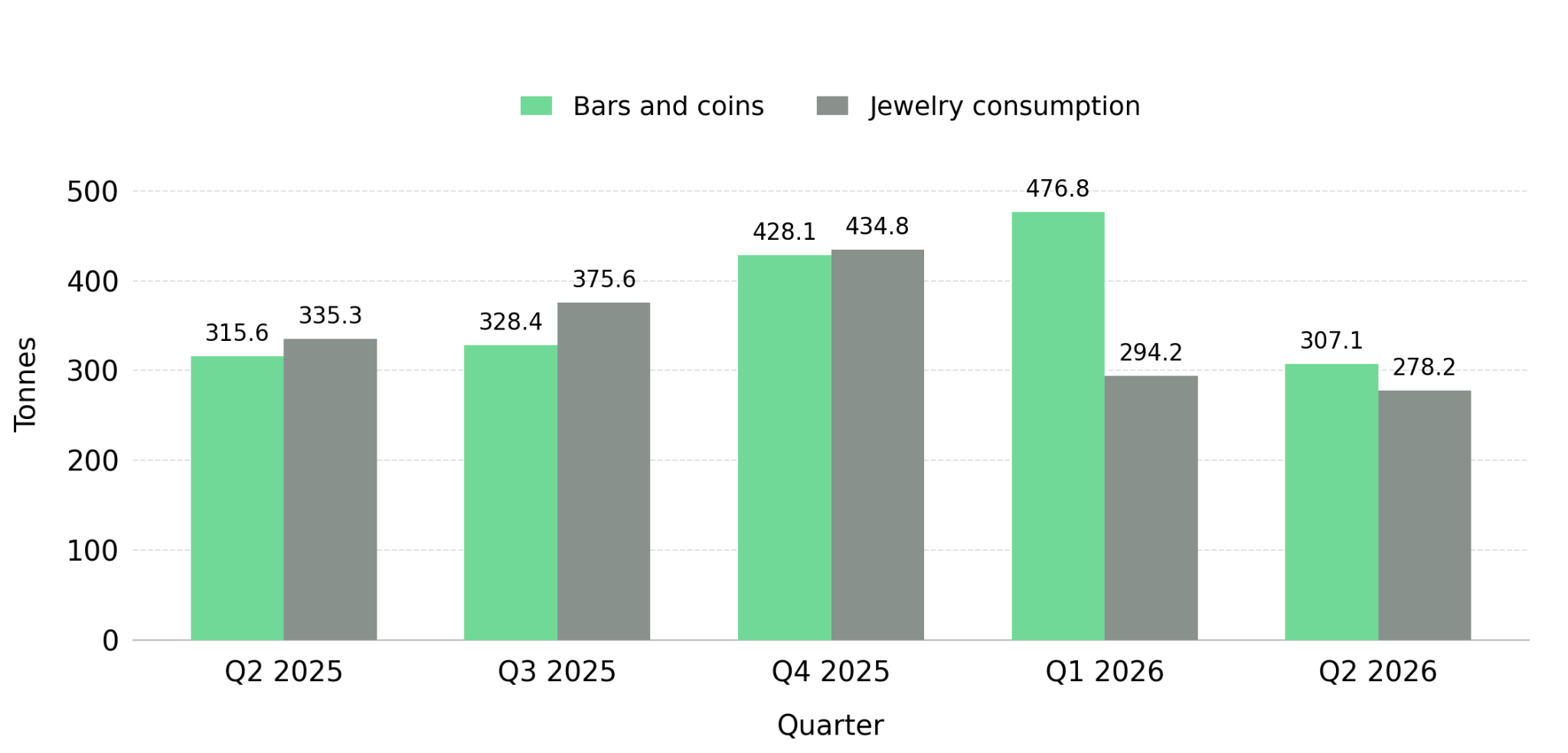
China bought a record 314 tonnes of gold bars and coins in the first half of 2026, more than twice its jewelry demand, the World Gold Council (WGC) reported. Spot gold still fell 3.1% to $4,155.67 an ounce on September 28 as oil lifted Fed rate-hike bets, while mine supply stayed nearly flat.
High Gold Prices Push Asian Buyers From Jewelry Into Investment Bullion
Second-quarter jewelry demand fell 17% year over year as Asian buyers shifted toward lower-premium bars and coins. Investment is the main potential driver of demand growth through 2026.
China's Tax Treatment Favors Bullion Even as Wholesale Physical Demand Softens
China's value-added tax (VAT) raises jewelry costs but spares investment products bought from Shanghai Gold Exchange (SGE) members. SGE withdrawals, a gauge of wholesale demand, still fell 27% year over year in August.
Indian Bullion Buying Reaches Its Strongest First Half Since 2013
India's first-half bar and coin demand reached 113 tonnes, though an import-duty increase from 6% to 15% cut second-quarter bullion buying 19% quarter over quarter.
Official Buying Carries Second-Quarter Demand While Gold ETFs Recorded Outflows
Central banks bought a net 288.9 tonnes in the second quarter, up 62% year over year, while gold ETFs shed 44.8 tonnes, so strength did not extend across every channel.
China's Central Bank Extends Its Buying Streak, but Annual Pace Slows
China's central bank added 20.2 tonnes in August, its 22nd straight monthly increase, but the WGC forecasts global official buying for 2026 below 2025.
Western ETF Inflows Return, Yet Rising Real Yields Threaten Further Demand
Global gold ETF holdings rose 121 tonnes in August to a record, led by North American and European funds, yet higher real yields raise the income forgone by holding gold.
Flat Supply Makes Mine Project Milestones the Key Signal for Output
Second-quarter mine output rose 2%, but a 6% drop in recycling held total supply near 1,268.9 tonnes. Long lead times slow the supply response to higher prices.
Sustained Throughput is What Turns First Gold Pours Into Commercial Production
Cabral Gold ($CBR) poured approximately 1,130 ounces at Cuiú Cuiú in Brazil and targets commercial production by the end of 2026. New Found Gold ($NFG) declared commercial production at Hammerdown in Newfoundland, producing 9,140 ounces in the first eight months of 2026.
Drill Results Expand Gold Potential While Permits Move Projects Toward Supply
Tudor Gold ($TUD) expanded the Perfectstorm system at Treaty Creek in British Columbia with ten new holes. U.S. Gold Corp ($USAU.US) holds the fully permitted CK Gold project in Wyoming, backed by a recent feasibility study. P2 Gold ($PGLD) targets a Q4 2026 resource update at Gabbs in Nevada, ahead of a feasibility study contemplating average annual gold production of 150,000 ounces.
The spread between realized prices and all-in sustaining costs (AISC) sets what remains for taxes, financing, and other cash needs.
Bullion Demand Supports Gold, but Producer Margins Decide Equity Value
Record Chinese bullion buying did not stop gold from falling once yields rose, so demand alone does not protect gold equities. Producers with repeatable output and wide AISC margins hold up best; developers gain ground through permits, financing, and economics viable below base-case prices. Oil and Treasury yields are the nearest pressure point, and re-rating follows commissioning mines proving steady throughput.
Read more: High Gold Prices Shift Asian Buyers Toward Bullion as Gold Supply Stays Flat
Disclosure: This article features Cabral Gold, New Found Gold, Tudor Gold, U.S. Gold Corp and P2 Gold as company examples. None of these companies influenced the topic, thesis, or conclusions of this article, and none exercised editorial control over its content.