

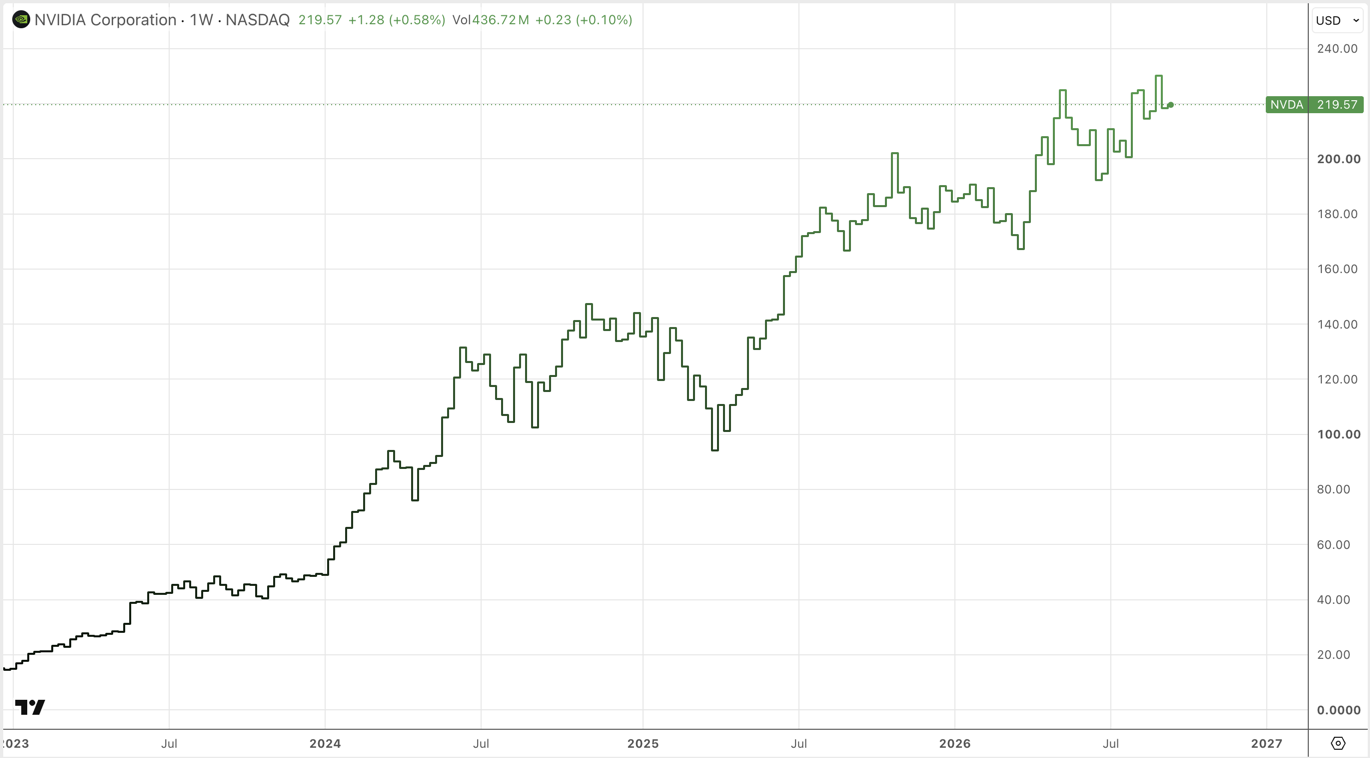
Nvidia continues to raise expectations regarding the scale of the next phase of the AI boom. After an unusually long‑term forecast predicting revenue growth of 70%, to $673 billion in the next fiscal year, Jensen Huang said he expects to sell twice as many chips as in the current year. At the same time, the main constraint on further growth is no longer demand, but the ability of the global infrastructure to support such a quantity of computing equipment.
According to Huang, investments in AI continue to spread to virtually every sector of the economy and every country. Nvidia usually does not disclose shipment volumes, but last fall the company reported that it shipped about 6 million Blackwell‑generation chips over four quarters. Now the focus is on further scaling not only of GPUs but also of CPUs, network equipment, and other components, which Nvidia is increasingly integrating into full‑fledged computing platforms.
In fact, the revenue growth forecast of up to $673 billion could be even higher if the company had sufficient supply. However, as production increases, the next infrastructure barrier to emerge is electricity. It is only possible to sell twice as many accelerators if data centers can connect and power the corresponding computing resources.
That is why Nvidia, together with Google and Emerald AI, is creating the AI Energy Management Alliance. Its goal is to develop standards that will enable AI data centers to flexibly regulate the load on the power grid. For Nvidia, this is not just an infrastructure initiative, but a way to expand the potential market for its own equipment without having to wait for many years of power grid modernization.
One example already shows the possible financial impact. Nvidia and Lambda have demonstrated that intelligent power management makes it possible to fit 19 computing modules within a single power budget instead of the usual 16, while also increasing performance per watt by approximately 25%. If this approach is scaled up to large data centers, operators will be able to install more accelerators without a proportional increase in available power.
This is especially important for Nvidia, since a classic 100 MW data center may leave up to 20% of the power budget in reserve due to losses, consumption spikes, and reliability requirements. Reducing this reserve even by a few percentage points effectively creates additional infrastructure capacity for new GPUs.
Meanwhile, the demand for accelerators remains so high that even US export restrictions have not been able to completely halt their penetration into China. Up to a third of China’s computing capacity may be built on accelerators imported in circumvention of the restrictions. The largest example was Megaspeed International, which imported American-made equipment worth $4.6 billion between 2023 and 2025.
The gray market is not a legitimate source of revenue for Nvidia, yet it still creates regulatory risk. Tighter control may require additional costs for auditing supply chains and limit sales through individual distributors. On the other hand, the very scale of illegal imports demonstrates both the size of the global shortage in advanced computing capacity and how much buyers are willing to pay for access to it.
Another potential limitation is emerging — AI safety. Anthropic's CEO has raised the concern, with OpenAI and xAI echoing it, and the discussion briefly weighed on Nvidia stock performance, with the effect spreading across major indices such as the S&P 500 and related derivatives like ES futures. Huang has already acknowledged that an unsafe product needs to be delayed and further refined. If this approach becomes an industry standard, the pace of new model releases may slow down, but for now the investment cycle shows the opposite trend.
As a result, Nvidia is gradually transforming from a supplier of accelerators into a company interested in eliminating all the constraints hindering the further growth of computing infrastructure. Initially, the bottleneck was the GPUs themselves, then memory and network equipment. Now it’s electricity and grid connections that matter most.
That is why Huang’s statement about doubling sales looks like more than just a demand forecast. To realize the potential $673 billion in revenue and continue growing, Nvidia has to effectively expand the physical boundaries of the market, ensuring that every available gigawatt of electricity can support more of its accelerators.