

M&A has been a hot topic lately. What happened at BEA is a textbook example of a governance‑driven acquisition, not a traditional negotiated transaction. HMS didn’t chase valuation debates or promotional cycles — they executed a staged, industrial control transaction with precision.
For a long time, Canadian juniors were the Vikings of the land — the explorers who found the deposits around the globe. Today, increasingly, it’s foreign industrial groups who end up developing them.
BEA’s case is particularly instructive because the takeover wasn’t sudden — it unfolded through a structured, sequenced, and legally prepared timeline spanning fourteen months.
Governance Timeline (2025–2026)
May 30, 2025 — Change of Control Resolution approved
June 26, 2025 — CEO resignation citing strategic European partners
July 23, 2025 — HMS representative appointed Interim CEO
Feb 26, 2026 — HMS exploration head appointed to BEA board
May 19, 2026 — HMS acquires 50.9% majority control
Oct 14, 2026 — HMS installs new Chairman and restructures board
May 30, 2025 — Change of Control Resolution approved
Shareholders voted 99.99% in favour of a Change of Control Resolution, legally enabling HMS, ERAG, and LaVo to become a control group under TSXV rules. Belmont invoked MI 61‑101 “Financial Hardship,” confirming the company needed strategic capital.
June 26, 2025 — CEO resignation citing strategic European partners
CEO George Sookochoff resigned, explicitly linking his departure to the approved Change of Control and the arrival of strategic European investors. He remained on the board to support the transition.
July 23, 2025 — HMS representative appointed Interim CEO
Belmont appointed Patrick Brandl — an HMS representative — as Interim CEO. This marked the first executive‑level alignment with HMS and signaled the beginning of a staged governance transition.
Feb 26, 2026 — HMS exploration head appointed to BEA board
Belmont added Dr. Thomas Unterweissacher, HMS’s Head of Exploration, to its board. This strengthened HMS’s technical and strategic influence inside BEA ahead of majority control.
May 19, 2026 — HMS acquires 50.9% majority control
HMS quietly acquired 43.3M shares through private block purchases, bringing its total to 67.5M shares (50.9%). This completed the equity takeover and made HMS the majority shareholder.
Oct 14, 2026 — HMS installs new Chairman and restructures board
Belmont announced the resignation of Chairman George Sookochoff and appointed HMS CEO Dennis Schwindt as the new Chairman, completing the governance consolidation.
The Silence Was Choreography, Not Indecision
For months, BEA released no drilling updates, no project progress, and no JV developments. That silence wasn’t drift — it was choreography. In staged control transactions, public communication often pauses while governance is being restructured behind the scenes. BEA’s quiet period aligned perfectly with HMS’s step‑by‑step consolidation of control, reflecting a deliberate transition rather than operational stagnation.
Market Reaction: Structural, Not Promotional
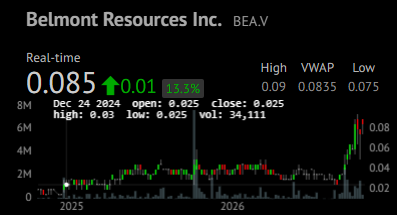
Retail investors often expect excitement or a valuation event when a new strategic group takes over. But the share price remained flat because the market recognized this for what it was: a governance consolidation, not a promotional transaction. Control deals rarely generate immediate price movement; they generate structural change.
The chart tells the same story: months of flat trading, low volume, and no operational catalysts — exactly what you’d expect during a quiet, staged control transaction rather than a promotional cycle.
The Broader Context: Canada’s Junior Ecosystem
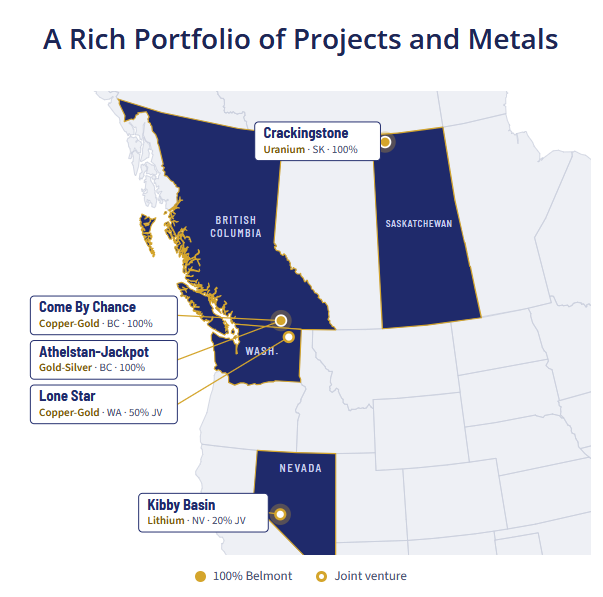
The underlying irony is that BEA’s assets are genuinely interesting — copper, lithium, uranium, and REEs. But in junior mining, assets alone do not determine outcomes. Governance, capital access, and execution capacity determine whether assets translate into value. HMS brought the missing components, and BEA’s identity shifted accordingly.
Canada’s broader structural context also matters. The country has world‑class geology but a fragile junior ecosystem. Regulatory burden is high, capital access is inconsistent, and government support for early‑stage resource companies is limited. As a result, many juniors operate with chronic underfunding and governance strain. In that environment, foreign industrial groups often become the only actors capable of stabilizing assets and executing strategic plans. BEA’s transition is not just an isolated M&A event — it reflects a systemic reality.
Conclusion
As a BEA shareholder, I welcome the stronger governance HMS brings. But the broader pattern is hard to ignore. BEA struggled until German control took over, and Canada has once again surrendered a domestic junior with meaningful assets into foreign hands.
RIP BEA, RIP Canada — not in an emotional sense, but in the structural sense that Canadian geologists continue to trek the world for good assets, only to hand them over to be developed by groups outside its borders.
Disclaimer: This post is for informational purposes only and is based solely on publicly available disclosures, including MD&A filings, financial statements, ASX releases, and Government of Nunavut grant announcements. It is not investment advice or a recommendation to buy or sell any security. Readers should conduct their own due diligence and consult a qualified financial professional before making investment decisions.