

Brent near US$105 per barrel has widened the running-cost advantage of electric vehicles (EVs), and Europe is already buying: battery electric vehicles (BEVs) took 21.7% of EU new-car registrations in the first eight months of 2026, up from 15.8% a year earlier. Carmakers can lift output within months. Copper mines need years to study, permit, finance, and build.
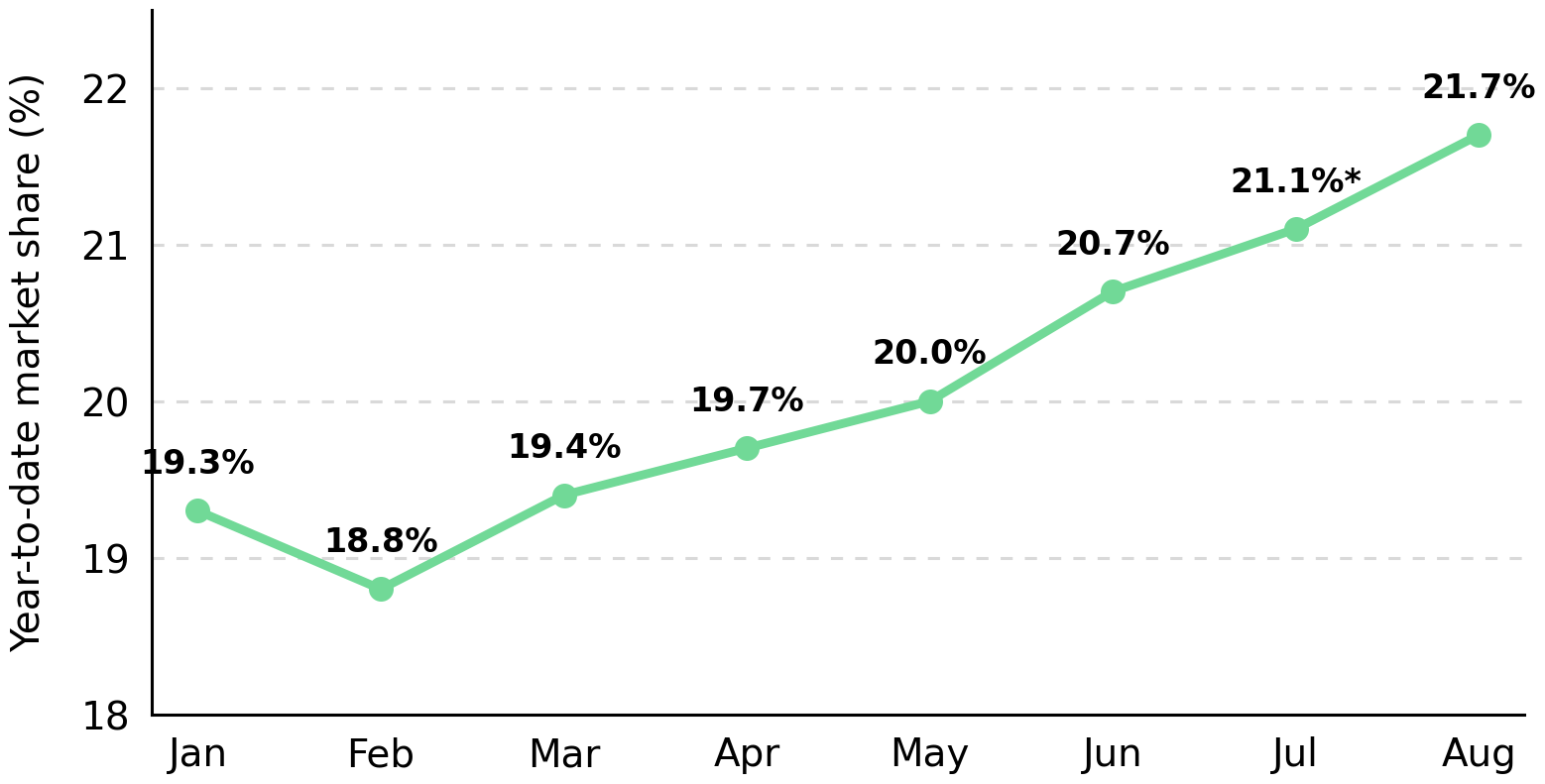
Fuel Inflation Widens the EV Running-Cost Advantage Over Combustion Vehicles
The International Energy Agency (IEA) placed Brent futures near US$105 per barrel on September 11, approximately 45% above pre-conflict levels. EU personal-transport fuel costs rose 23.8% year on year in August. At April oil prices, annual EU fuel savings from driving an EV were 35% higher than in 2025, narrowing a European BEV purchase premium of approximately 20% over comparable internal combustion engine (ICE) vehicles. The IEA projects 23 million global electric-car sales in 2026.
Europe's Registration Surge Extends Copper Demand From Vehicles Into Grids
EU BEV registrations reached 1,641,333, with France up 74.2% and Germany up 53.1%, while gasoline and diesel registrations each fell 18.6%. Each BEV adds copper in the vehicle, its charging connection, and local distribution equipment. Adoption is uneven: August BEV and plug-in hybrid sales rose 36% in Europe but fell 11% in China and 33% in North America.
Faster Adoption Lifts Required Annual Copper Mine Additions to 960,000 Tonnes
Wood Mackenzie estimates faster EV adoption would raise required annual copper mine-capacity additions through 2040 from approximately 850,000 tonnes to 960,000 tonnes. A separate accelerated-adoption scenario requires about US$25 billion of additional copper investment. Supply growth favors projects with room to scale.
Marimaca Copper ($MARI) returned 216 meters grading 0.96% copper and 7.2 grams per tonne silver at Pampa Medina, where step-out drilling points to a larger copper-silver system that could complement the nearby Marimaca Oxide Deposit.
Only Sustained Fuel Costs Convert Cheaper Running Costs Into Vehicle Orders
A brief oil spike improves the cost comparison without a matching rise in orders. Oil below approximately US$60 per barrel, slower EV price declines, or expensive charging would weaken the pull-forward. A slower transition removes only the accelerated increment, not baseline copper requirements.
Existing Infrastructure Shortens the Restart Path for Brownfield Copper Projects
Usable processing plants, roads, and power reduce new construction when engineering confirms they remain suitable. Selkirk Copper ($SCMI) outlined a 13-year mine restart in a preliminary economic assessment (PEA), with an after-tax net present value of C$494 million at a 7% discount rate, and existing infrastructure reducing restart requirements.
For oxide deposits, recovery and acid consumption set saleable output. Fitzroy Minerals ($FTZ) reported 21-day mini-column copper recoveries of up to 82.6% at Buen Retiro, supporting heap leaching; confirmation in larger columns is the next test of processing risk.
Grade Continuity and Funded Drilling Build the Pipeline Beyond Near-Term Builds
Earlier demand raises the value of discoveries that can mature into future supply. Abitibi Metals ($AMQ) reported 60.2 meters grading 1.25% copper equivalent at B26, with up to three rigs planned for resource definition and expansion through the rest of 2026.
At Manna Hill, Cobra Resources ($COBR.L) returned 23 meters grading 0.63% copper from Blue Rose, with follow-up drilling aimed at defining a larger copper system.
Mogotes Metals ($MOG) plans up to 50,000 meters of drilling at Beskauga, alongside Filo Sur, with initial Beskauga assays targeted for the fourth quarter of 2026 and a PEA within 12 months.
Long Mine Lead Times Reward Projects Closest to Their Next Decision Point
Elevated fuel costs are bringing EV-driven copper demand forward faster than mines can respond. Higher oil prices change the timing of copper demand, not its direction, which favors projects already holding approvals, usable infrastructure, tested recoveries, or funded drilling. Re-rating follows if oil holds well above US$60 while EV prices keep falling, with fourth-quarter assay results the nearest test.
Read more: Oil Shock Accelerates EV Adoption, Pulling Copper Demand Forward
Disclosure: This article features Marimaca Copper, Cobra Resources, Selkirk Copper, Fitzroy Minerals, Abitibi Metals, and Mogotes Metals as company examples. Neither company influenced the topic, thesis, or conclusions of this article, nor did either exercise editorial control over its content.