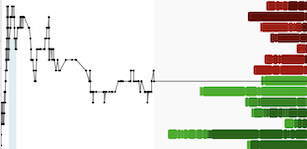


The US Energy Information Administration estimates 6.7 million barrels per day of Middle Eastern crude was shut in during August 2026, up from 5.0 million in July. Existing Saudi and Emirati bypass pipelines offer roughly 4.7 million barrels per day, against normal Hormuz flows above 20 million. The gap is why oil in the reservoir and oil that can reach a buyer are no longer the same asset.
Shut-Ins Removed Physical Supply Rather Than Only Raising the Cost of Shipping
A shut-in reduces output when storage or export capacity runs out, so the Gulf disruption cut barrels rather than merely raising the cost of moving them. August shut-ins reached 3.55 million barrels per day in Saudi Arabia, 1.16 million in Iraq and 1.00 million in Iran. Fourth-quarter shut-ins are forecast to average 5.7 million, but that forecast used inputs finalized on September 3, before the later disruption to Saudi Arabia's East-West pipeline.
Bypass Pipelines Cover Less Than a Quarter of Normal Flows
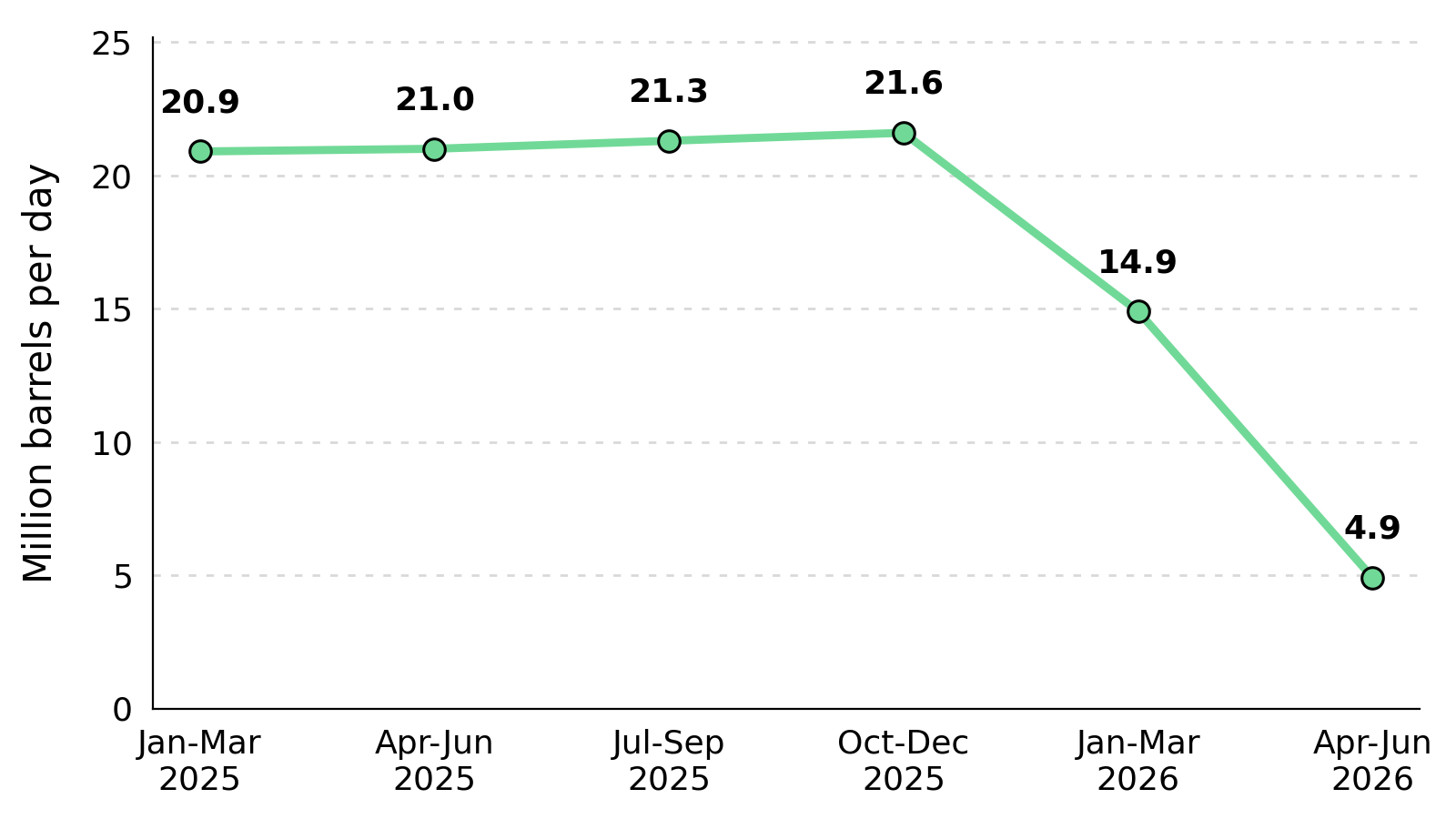
About 20.9 million barrels per day of crude, condensate and petroleum products moved through Hormuz in the first half of 2025, close to 20% of global petroleum liquids consumption. The combined Saudi and Emirati bypass lines offer about 4.7 million barrels per day. Stated capacity also overstates deliverable supply, because a pipeline needs oil at the inlet, an available outlet and a workable route to buyers.
Hormuz Traffic Ran 13.1 Million Barrels a Day Below Pre-War Levels
Hormuz flows averaged 7.6 million barrels per day in August. Saudi and Emirati bypass-port exports climbed from 4.1 million in February to 7.8 million in June before falling back to 5.5 million in August. Bypass routes, stock draws and weaker demand held the third-quarter deficit to 1.7 million barrels per day, far below the loss of Hormuz traffic.
Inventory Draws Are Covering a Shortfall They Cannot Cover Twice
Observed inventories fell 95 million barrels in August, taking cumulative draws since February to 507 million. Global stocks declined at an average 3.9 million barrels per day in the second quarter, with further draws forecast at 3.0 million in the third and 1.7 million in the fourth. Stored oil is absorbing the export loss, which leaves a thinner buffer against the next one.
Freight & Discounts Take Back Part of Any Price Gain
Operators targeted roughly 2.5 million barrels per day of Gulf of Oman ship-to-ship transfers in September, up from 1.4 million in August. Freight for very large crude carriers running Gulf oil to China exceeded US$30 per barrel, and crude discounts may still be needed to keep delivered prices competitive. Higher Brent prices therefore do not guarantee wider upstream margins when transport costs and discounts absorb part of the increase.
Onshore Routes Trade Chokepoint Risk for a Short Haul to the Refinery
Turkey produced 6.68 million tonnes of crude but imported 31.94 million tonnes in 2025, leaving 83% import dependence and an established domestic buyer for local barrels. That is why nearby refinery access carries a premium while seaborne routes stay constrained. Dune Oil ($DUNE.CN) holds a 29% working interest in Block M47, roughly 130 kilometers from the 1.4-million-tonne Tupras Batman refinery, and estimates a US$ 50 per barrel netback at US$ 72 oil. C-1 production testing is targeted for fall 2026.
Route Access Now Belongs in the Model Alongside Quality
Recoverable barrels and saleable barrels have separated, and the spread sits in freight and shut-in volumes rather than in reserve statements. Upstream models should carry delivery cost and refinery proximity as explicit inputs rather than read Brent alone. The premium unwinds when Hormuz and bypass exports rise and inventories rebuild, a recovery targeted for the second quarter of 2027.
Read full article here: 6.7 Million Barrels per Day Gulf Shut-Ins Expose Oil’s Route-to-Market Risk
Disclosure: This article features Dune Oil as a company example. The company had no influence over the topic, thesis, or conclusions of this article, and exercised no editorial control over its content.