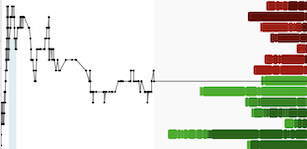


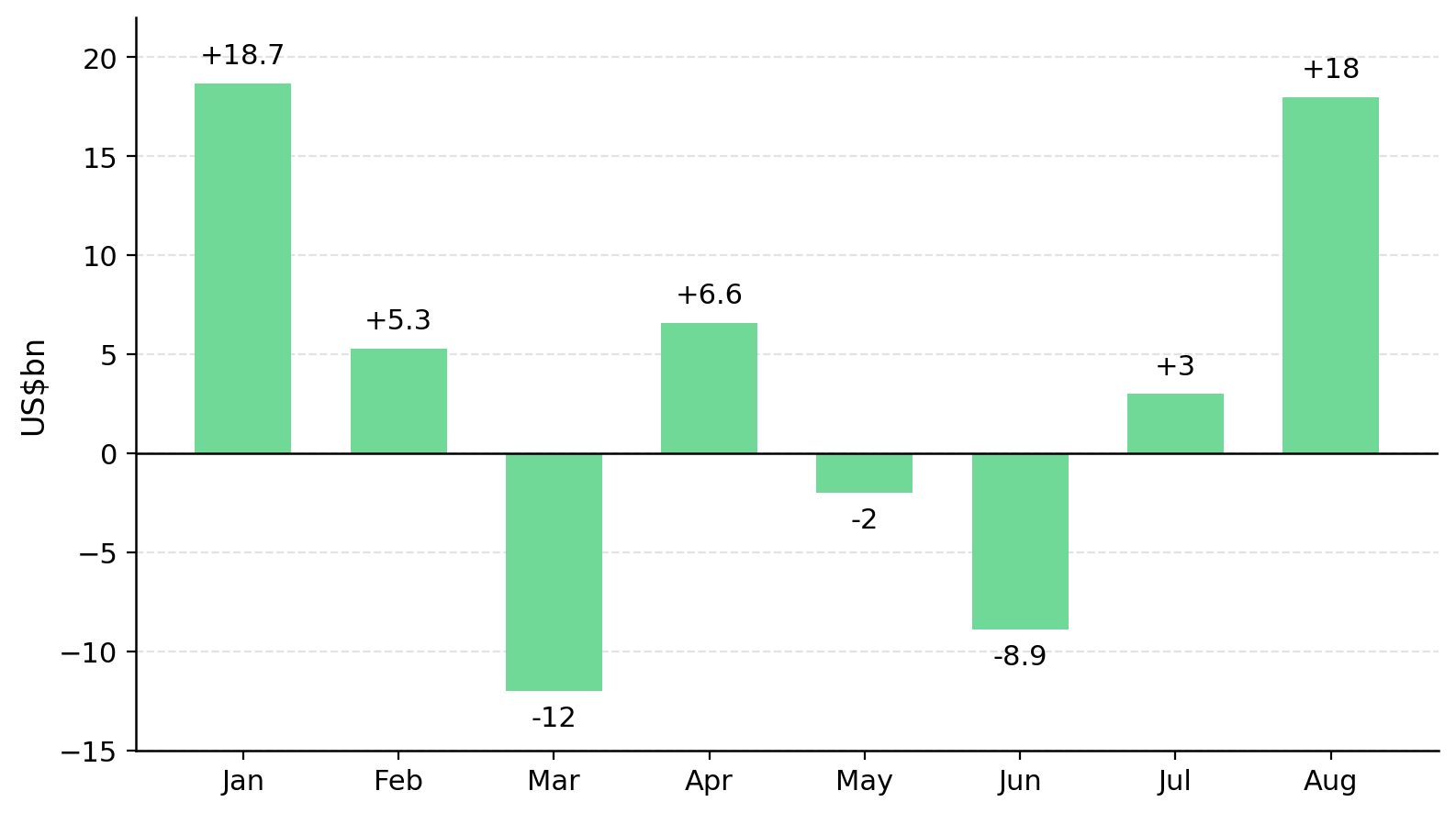
Global gold exchange-traded funds (ETFs) added more than 70 metric tons in September even as gold fell more than 8%. Gold still held above US$4,000/oz while mine output grows only slowly, a gap favoring mines already producing gold.
Gold ETF Buying Held Firm Even as Futures Selling Drove Prices Lower
COMEX Managed Money positions fell by 83.7 metric tons equivalent in September and spreading positions by 156.2 metric tons, helping explain the price drop while physically backed ETF holdings rose. August's 121-tonne inflow had already lifted global holdings to 4,189 metric tons, so September extended accumulation rather than reversing it.
Gold Above US$4,000 Keeps Revenue per Ounce High for Producing Mines
The World Gold Council (WGC) reported a Friday close of US$4,190/oz after the correction. For producing mines, the realized price level, not the drop from earlier highs, sets revenue per ounce.
Average producer all-in sustaining costs (AISC) rose 16% year over year to US$1,785/oz in the first quarter, yet stronger prices lifted average AISC margins to a record. Mineros S.A. ($MSA) grew first-half adjusted EBITDA 70% to US$260.5 million as its realized gold price climbed, adding capacity and funding growth internally.
Production Converts Strong Realized Prices Into Internal Funding
Higher realized prices create the most leverage where existing output already generates cash after capital spending. Serabi Gold ($SBI) generated US$34.8 million of first-half net operating cash inflow after mine development spending and remains debt-free, funding resource growth from internal cash.
New Production Earns Cash Immediately at Today's Prices
Operations reaching production while prices stay high generate cash without needing a further price rise. New Found Gold ($NFG) reached commercial production at Hammerdown on August 19, building a cash base while it advances the larger Queensway Gold Project.
Keith Boyle, Director and Chief Executive Officer of New Found Gold, links commercial production directly to cash generation:
"We're in commercial production at 20,000 to 25,000 oz a year with all-in sustaining costs of $2,500/oz, and we're generating cash flow targeting an annualized $40 million."
Higher Gold Prices Turn Lower-Grade Rock Into Economic Mine Feed
When lower-grade material becomes economic, existing mines can push more tonnes through established infrastructure. West Red Lake Gold Mines ($WRLG) lifted second-quarter production 51% sequentially at Madsen and turned free cash flow positive.
Shane Williams, President and Chief Executive Officer of West Red Lake Gold Mines, explains how gold prices reshape the mine plan:
"With the increasing gold price, cut-off grade can come down a lot more, which allows a lot more material and allows us to switch to long-hole mining."
Operating Cash Flow Now Funds Expansion With Less Need for Equity
TRX Gold ($TRX) is building a new processing circuit at Buckreef from operating cash flow, intended to more than double processing capacity without near-term reliance on external equity.
Stephen Mullowney, Chief Executive Officer of TRX Gold, explains how gold cash flow funds mine expansion:
"Right now, we have a US$80 million run-rate EBITDA at US$4,000 gold, and that run-rate EBITDA will go to US$200 million to US$250 million in two to three years as we execute that business plan."
High Grade Ore Cuts Costs and Converts Revenue Into Cash
Value of current production depends not only on realized gold prices but also on how efficiently each ounce is produced. Higher-grade ore can support greater output at lower unit costs, increasing the amount of revenue converted into cash flow.
Integra Resources ($ITR) is moving Florida Canyon toward higher-grade central ore bodies, which management says should lower costs and support an annual run rate of 80,000 to 85,000 ounces.
Slow Mine Supply Growth Gives Existing Producers a Timing Advantage
New supply requires drilling, permitting, financing and construction. First-half global mine production rose 3% to a record 1,867 metric tons, and WGC expects only modest growth from mining and recycling. Existing mines respond sooner through higher throughput, lower cut-off grades and brownfield additions. ETF demand does not guarantee a higher near-term price, and gold remains sensitive to real yields and the US dollar.
Existing Mines Capture Today's Gold Prices Before New Supply Arrives
Investment demand held through an 8%+ correction while mine supply grows slowly. Producers with disciplined AISC, rising throughput and self-funded brownfield growth convert current prices into cash first, making execution at existing operations worth more than distant greenfield ounces. Continued ETF buying with gold above US$4,000/oz is the condition for a broader producer re-rating, and October's WGC flow data is the nearest test.
Read more: 70-Tonne ETF Inflows Reinforce Current Gold Output Advantage
Disclosure: This article features Mineros S.A., Serabi Gold, New Found Gold, West Red Lake Gold Mines, TRX Gold and Integra Resources as company examples. None of the companies had influence over the topic, thesis, or conclusions of this article, and none exercised editorial control over its content.